
Home expansion in Los Angeles has its own set of factors to consider. You love your neighborhood, the schools, and the sense of community, but you have simply outgrown your space. Your family may have expanded, or you may simply need the dedicated home office that many of us have come to realize we need in recent years.
This leads you to an important question: are you looking to build up or build out?
Making the right choice after months of research is crucial in one of the most active property markets in the country. Recognizing the difference between expanding your home vertically versus horizontally is the first step towards adapting your home to fit your lifestyle. We’ll provide you with a simple framework to assess your property and budget, as well as what’s important to you, so you can make the right decision that adds value and function to your Los Angeles home.
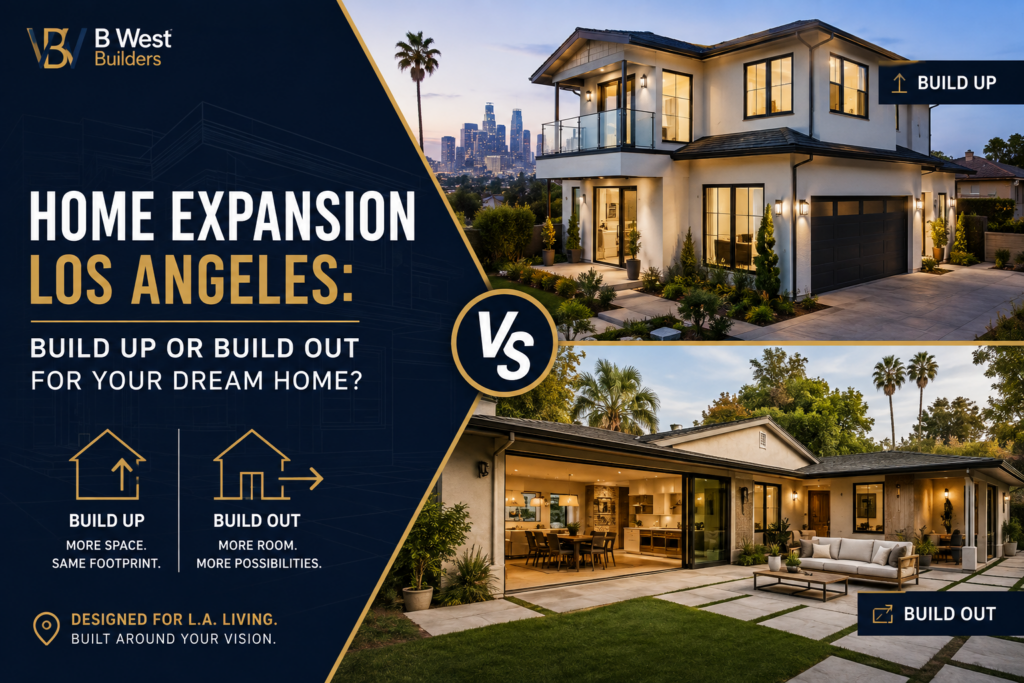
The Difference Between Vertical and Horizontal Expansion
Before you start to draw any lines on a plan, we will see what kind of expansion actually means for your house. Adding space is more than just an addition; it is about changing the footprint of the property.
A Second-Story Addition Could Be Called 'Building Up'
To build up means to add an entire new story to your existing one. You can think of it as building a new house atop an old one. Most often, this entails reinforcing the existing foundation, carefully deconstructing the roofing, erecting new walls and roofing above, and inserting a staircase into your existing floor plan. These projects might involve a temporary move-out and are quite structural in nature.
'Building Out' Considers Extending Out at Ground Floor
To build out a house means to create more space by expanding the structure horizontally. You push the footprint of the house farther out into your yard. Potentially, it could be a new extended living room reaching into the backyard, an additional bedroom off to the side, or a new bigger kitchen. Typically, this process entails new foundation work, extending plumbing and electrical lines underground, and integrating the new area with your existing ground floor. The usable outdoor area is affected directly.
Understanding Los Angeles Zoning and Permits
When you’re planning home renovations in Los Angeles, it’s imperative to know zoning laws are the law, not guidelines. Many owners soon find out that their choices are already made.
Lot Coverage and Setbacks for Building Out
The R1 zoning in Los Angeles is known for designating single-family dwellings, with a slew of exact rules on how much of your lot you can build on. The limit on how much of your property can be covered by your house is called the lot coverage ratio. If you live on a standard 5,000 square foot lot, then you probably have a limit of 40%. This means your house can only cover 2,000 square feet of land (along with any other structures that are part of your home, including a garage). If your home has already reached this limit, a build-out is often not an option. The distance that your home must be from your property lines also specifies where you can’t grow horizontally.
Height Restrictions and Neighborhood Character for Building Up
Constructing out faces the obstacle of lot coverage. Building up faces the rules. Los Angeles has height restrictions and usually limits residential buildings to 25 feet to 35 feet depending on the zone. In certain locales, view ordinances prevent neighbors from losing scenic outlooks, so a second-story addition would not be possible. You can regularly find Historic Preservation Overlay Zones (HPOZs) in areas like Silver Lake or Hancock Park. These HPOZs can drastically limit any vertical additions to a house. The reasoning is that they deter vertical alterations to preserve a neighborhood’s original single-story character. For example, adding a second story to a classic California bungalow will pose an unnecessary aesthetic and regulatory challenge.
What to Expect: Permitting Process with LADBS
Regardless of whether you build up or build out, both require extensive permitting through the Los Angeles Department of Building and Safety (LADBS). The process will take about 6-8 weeks in the off-season but will take about 3-4 months in peak season, such as spring, once we submit the plans, i.e., architectural and structural plans, for review. To ensure smooth approval and permit issuance, it is essential to partner with architects and contractors who are well-versed in LADBS procedures. If plans are incomplete or architects or consultants are not familiar with local codes, it adds months of delays and thousands of dollars on the back end in extra costs.
Comparing the Costs of Building Up Versus Out – A Financial Analysis
For many homeowners, money can be the biggest concern when it comes to family home improvements. In Los Angeles, construction costs are higher than the national average, so it’s important to understand each option’s specific cost drivers.
Building Out Incurs Higher Foundation Costs
The horizontal extension of your home means digging. This usually incurs the cost of new excavation, pouring a whole new foundation, and possibly extensive trenching for new plumbing, electrical, and gas lines. You’ll also have to consider site work and possibly re-grading your yard, which can add up cost-wise, especially if the land is not level.
The Expenses of Building Up That Enhance Structure
Adding another story might seem like you won’t need new foundation work, but that’s a misconception. Likely, the existing foundation and walls were not designed to support another full floor. If you want to reinforce the structure, expect to pay heavily. This might involve new footings, perhaps shear walls, and steel beams may be required. Moreover, it is a difficult task to remove and replace the roof. This will include the cost of scaffolding and cranes to lift materials.
For a big addition in Los Angeles, expect to pay around $450-$700 per square foot for the construction (not including high-end finishes or further site work). While the per-square-foot cost for building up may sometimes be a bit lower because you are leveraging existing infrastructure, the structural reinforcement cost is often higher. Building out frequently incurs greater overall foundation expenses. In conclusion, the two approaches are expensive. You should always add an additional 15-20% contingency for unforeseen issues, especially so for older LA homes where problems, like knob-and-tube wiring and unpermitted previous work, are not uncommon.
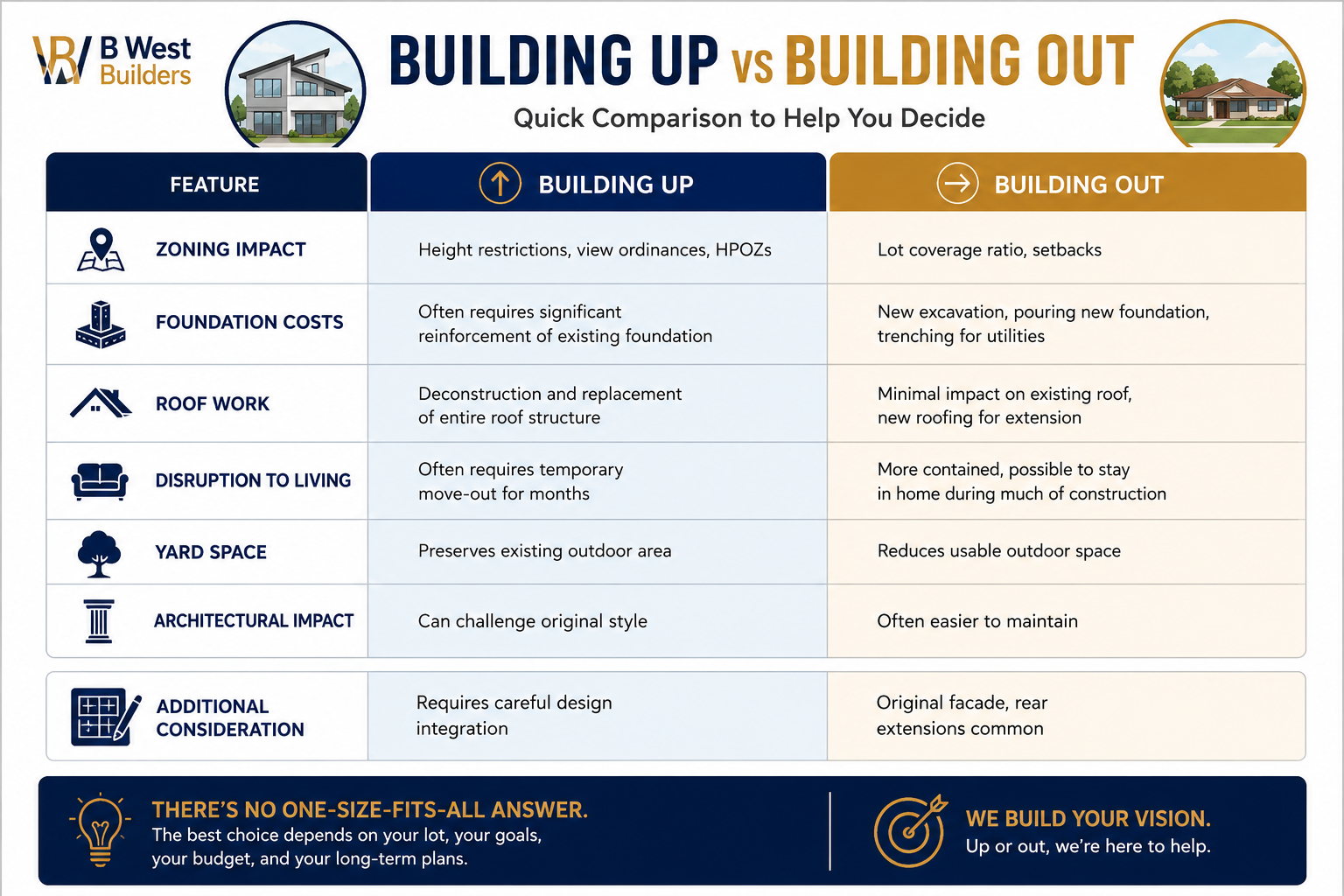
Quick Comparison: Building Up vs Building Out
Lifestyle & Function: Architecture to Suit Your Family’s Future
Your expansion should enhance your daily experience, not merely exist on paper. The decision to build up or build out will impact how your family lives in and uses the house for years to come.
Seamless Indoor-Outdoor Living Through a Building with Large Openings
A ground-floor extension makes indoor-outdoor connections more impactful, something which is always sought after with the Southern California weather. Picture your own great room with big sliding doors opening to your backyard, ideal for entertaining. According to an article published in Realtor.com, building out is perfect for adding accessible spaces like a ground-floor primary suite or an in-law unit. This is very important for multi-generational families.
Creating Private Spaces and Views with Vertical Expansion
Constructing a second floor is a common option for creating private spaces. Imagine a luxurious primary suite above the main living area that could serve as a private oasis away from it all. Not only does it create physical division, but it also works for a playroom or a dedicated home office. Many homeowners choose to go up to gain views of the city or a hillside that wouldn’t be possible otherwise.
Your Yard Space: An Expensive Commodity in Los Angeles
The space you are building out on is your yard. Outdoor space in Los Angeles is a big deal and a must-have for kids, pets, or simply your own relaxation and gardening. Are you ready to exchange walls for something way more valuable? Building up keeps your yard intact, providing green space for your family’s enjoyment.
Delays in Construction Schedule and Site Disruption
Experiencing a renovation is not glamorous. There is a significant disruption with both kinds of additions, but they disturb very differently. Recognizing these truths will allow you to plan financially.
The 'Building Up' Move Out Reality
Homeowners often do not realize that putting on a second story often requires you to leave your house for a period, and sometimes for months. When the roof comes off your home, it becomes dangerously exposed to the elements, making it unsafe. Planning for the costs of temporary housing while the project is going on is something many people forget to put on their budget.
The 'Building Out' Gets to Controlled Chaos
Despite the mess and noise from having contractors in your home, disruption to daily life is sometimes more contained. In many instances, the main living spaces can be blocked off, allowing your family to stay in your home during much of the construction. The integration of the new addition with the old results in a short but intense phase known as the breakthrough. Be prepared for more noise than usual, and access may be limited to some areas. If the addition is significant, then it will take about 6-9 months to fully complete. The permit processing alone takes about 2-4 months.
Architectural Integrity Will Increase Your Curb Appeal
Your home is probably your most valuable asset, and its looks matter. To make sure your addition does not look “tacked-on” but intentional, carry out the construction in such a way that you can enjoy your property as well as ensure an increase in property value.
Struggles in Designing a Unifying Upper Floor
Some homes cannot be outfitted with a second story so easily. When a low-slung mid-century modern home or Spanish-style bungalow has a boxy second floor added on, it can look awkward and diminish the original architectural style of the home. The challenge consists of making a design that links up with the existing one and provides functionality. Sometimes, an architect skilled in your home’s historical period would be required.
It Is Important to Create a Harmonious Extension
Constructing outwards often allows for greater flexibility in retaining the original facade and curb appeal of your home. A rear extension can create a modern open-plan living space without impacting the street view. In HPOZ areas, where exterior changes are scrupulously reviewed, this is most critical. A well-designed extension can enhance the character of the home, seamlessly harmonizing both periods instead of creating a jarring clash.
Which Expansion Option Creates Greater ROI?
You want to get returns from your large investment. While you might be considering family home improvements that would enhance your lifestyle, you would also be looking to increase the value of your property.
The Worth of Bedrooms and Bathrooms
In general, you can expect to see a good return on investment from bedroom and bathroom additions. In Los Angeles, adding a second story to a two-bedroom house to create four bedrooms often leads to a very high increase in market appeal.
The Risk of Over-Improvement
Your home could be “over-improved.” If the renovation you make makes your home considerably larger or more luxurious compared to other homes in your immediate neighborhood, then it may be hard to sell. Before making a commitment to any renovation project, it’s a good practice to always check the neighborhood comparable sales (“comps”). Also, talk to a local agent.
The Usefulness of an Addition Defines Its Value
The best ROI often comes from additions involving a critical functional problem or a common buyer desire. This could be adding a much-needed bathroom, creating a functional open plan kitchen, or carving out a functional office. Choosing to build up or build out involves considering not just the available options, but which is the most desirable and usable space for your specific property and neighborhood.
Making Your Journey Easier: A Home Renovation Planning Framework
Ready to progress ahead? Home renovation planning is essential for a successful project. Learn how to make your dream a reality.
Define Your ‘Why’ and Your Budget
What particular difficulty are you attempting to resolve? What’s most important to you: privacy, space, or functionality? Next, set a firm maximum budget. Be realistic and add that 15–20% contingency fund. Knowing your financial limits from the beginning influences every decision.Research Your Property’s Zoning
If your property is located in LA City, visit the ZIMAS website. Discover your zoning designation, lot coverage limits, setbacks, and HPOZ restrictions by simply entering your address. This will help you see what type of expansions are even feasible on your lot.Get Going With Your Professional Team
Don’t do it alone. For the expertise needed for your home project, start by calling a local architect or design-build firm. These pros know the LA zoning rules, the LADBS permitting process, and the challenges that come with building here. With them, you can look for the best alternatives, get an accurate costing, and handle the entire process confidently.
Final Thoughts
As a homeowner in Los Angeles, choosing to build up or build out is one of your biggest decisions. The right answer meets your specific property, budget, and lifestyle needs, NOT a better answer. By taking into account zoning regulations, financial considerations, daily disruption, and your family’s long-term goals, you can make the right move. The next step you should take is to contact a Los Angeles design-build firm or architect. With their expertise, you will determine the viability of the property. Thus, the success of the project will determine if your home renovation gives positive value.
Frequently Asked Questions About Home Expansion in Los Angeles
What is the main difference between building up and building out?
Building up involves adding a second story to your existing home, expanding vertically. Building out means extending your home horizontally into your yard, increasing its ground-floor footprint. Both methods aim to add space but impact your property and lifestyle differently.
How do Los Angeles zoning laws affect home expansion?
Los Angeles zoning laws, like R1, impose strict rules. Building out is limited by lot coverage ratios and setbacks from property lines. Building up is restricted by height limits (typically 25-35 feet), view ordinances, and Historic Preservation Overlay Zones (HPOZs), which can prevent vertical additions.
What are the typical costs per square foot for home additions in LA?
For a significant home addition in Los Angeles, expect to pay around $450-$700 per square foot for construction, not including high-end finishes or extensive site work. It's crucial to budget an additional 15-20% contingency for unforeseen issues, especially with older LA homes.
Will I need to move out during a home expansion project?
If you are building up, a temporary move-out is often required for several months, as removing the roof makes the home unsafe and exposed. For building out, disruption is usually more contained, allowing families to stay in the home for much of the construction, though some areas may be inaccessible.
Which type of expansion offers a better return on investment (ROI)?
Both building up and building out can offer good ROI, especially when adding bedrooms and bathrooms. The best ROI comes from addressing a critical functional problem or a common buyer desire. Avoid over-improving your home compared to neighborhood comps, and always consult a local agent.
How long does the permitting process take in Los Angeles?
The permitting process through the Los Angeles Department of Building and Safety (LADBS) typically takes 6-8 weeks during the off-season. However, during peak seasons like spring, it can easily extend to 3-4 months after architectural and structural plans are submitted. Incomplete plans can cause further delays.
Ready to Transform Your Los Angeles Home?
Whether you choose to build up or build out, our expert team ensures a seamless, compliant, and value-adding home expansion.
Why Choose Our Construction Experts:
- Licensed & Insured Professionals
- Deep Expertise in LA Zoning & LADBS Procedures
- Transparent Pricing & Detailed Project Planning
- Proven Track Record of Client Satisfaction
Get Started Today:
- Call: (213) 410-4183
- Schedule: Book a complimentary property assessment online
- Special Offer: Get a detailed project estimate today!